What Is an AI Agent? (They Are About to Replace Your Assistant)
Remember 2023? We were all blown away that a computer could write a poem or summarize an email. We spent hours typing prompts into a box, waiting for text to appear.
That was the “Chatbot Era.” Welcome to the “Agent Era.“
If you are still just talking to your AI, you are using yesterday’s technology. The buzzword of 2026 isn’t “Generative AI“—it’s “Agentic AI.”
But what exactly is an AI Agent? Is it just a smarter ChatGPT? And which one should you actually trust with your credit card? Let’s break it down in plain English.
The Simple Definition: Brains vs. Hands
The easiest way to understand an AI Agent is to compare it to the AI you already know (Large Language Models or LLMs).
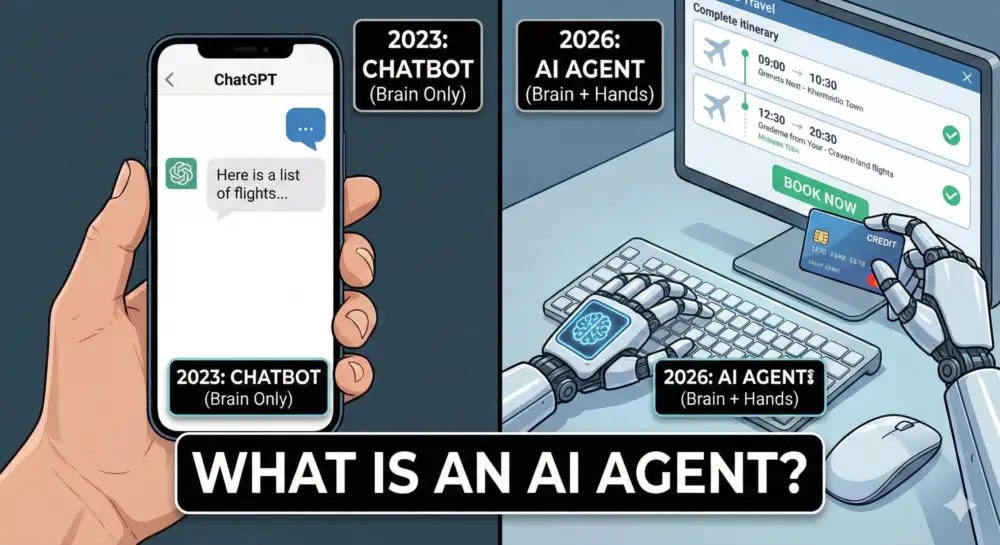
- An LLM (like basic ChatGPT) is a Brain in a Jar. It is incredibly smart. It has read the entire internet. But it is disconnected. If you ask it to “book me a flight to London,” it will write a lovely list of flight options, but it cannot actually buy the ticket. It has no hands.
- An AI Agent is that same Brain, but with Hands and Feet. It has permission to use software tools. It can open a browser, click buttons, enter your credit card details, send emails, and update your calendar.
In short:
- Chatbot: “Here is a list of flights.”
- AI Agent: “I booked the Delta flight leaving at 9 AM. The receipt is in your inbox.”
Is ChatGPT an AI Agent?
The answer is: It depends on how you use it.
- The old ChatGPT (Classic Mode): No. It was just a text generator.
- The new ChatGPT (with “Operator” or Plugins): Yes. When ChatGPT can browse the web, execute Python code to analyze a spreadsheet, or connect to your Expedia account to book a hotel, it is acting as an Agent.
It is no longer just thinking; it is acting.
What Does an AI Agent Actually Do? (Real Examples)
Agents aren’t sci-fi anymore. They are likely already running in the background of your workplace. Here are three real-world examples:
1. The “Coding” Agent (e.g., Devin)
You don’t ask this agent to “write code.” You give it a job.
- You: “Build a website for my shoe store.”
- The Agent: Creates the files, writes the HTML/CSS, sets up the database, tests for bugs, fixes the bugs it found, and deploys the site to the internet. You just watch.
2. The “Executive Assistant” Agent (e.g., Microsoft Copilot)
It lives in your email and calendar.
- You: “Plan a meeting with the marketing team next Tuesday.”
- The Agent: Checks everyone’s calendar, finds a free slot, books the room, creates the Zoom link, sends the invites, and drafts an agenda based on your last email thread.
3. The “Shopping” Agent (e.g., Google Gemini/Astra)
- You: “Find me that red jacket Ryan Reynolds wore, but under $100.”
- The Agent: Scans 50 online stores, compares prices, checks shipping times, and puts the best one in your cart (or buys it, if you trust it that much).
Who Are the “Big 5” AI Agents?
In 2026, the landscape is dominated by five major players who are racing to be the “Operating System” of your life.
- OpenAI “Operator”: The evolution of ChatGPT. It’s the best “Generalist.” Great at web browsing and handling complex, multi-step tasks like “Plan my entire vacation.”
- Google Gemini (Astra): The “Ecosystem” King. Because it connects to Maps, Calendar, Gmail, and Flights, it is the best agent for managing your personal life.
- Anthropic Claude (Computer Use): The “Worker.” Claude is unique because it can literally look at your computer screen and move your mouse to click things, just like a human. It’s the favorite for office admin tasks.
- Microsoft Copilot: The “Corporate” Agent. It dominates the business world because it lives inside Excel, Word, and Teams. It turns “data” into “powerpoints” automatically.
- Devin (by Cognition): The “Specialist.” While the others do everything, Devin focuses purely on software engineering. It’s an agent that can act as a standalone employee.
Which Is the Best AI Agent?
There is no single “Best” because they have different personalities.
- Best for Coding: Devin (Hands down. It fixes its own mistakes).
- Best for Personal Life: Google Gemini (It knows your email and calendar better than you do).
- Best for Complex Research: OpenAI Operator (It rarely hallucinates and digs deep).
- Best for “Clicking Things for You”: Claude (The “Computer Use” feature is unmatched for legacy software).
The Bottom Line
We are witnessing a shift from “Prompt Engineering” (knowing what to say) to “Goal Delegation” (knowing what to ask for).
An AI Agent doesn’t want to chat with you. It wants a mission. So, the next time you open your AI app, don’t ask it a question. Give it a job.
Are you using an AI agent yet, or do you still do everything manually? Let me know in the comments!